
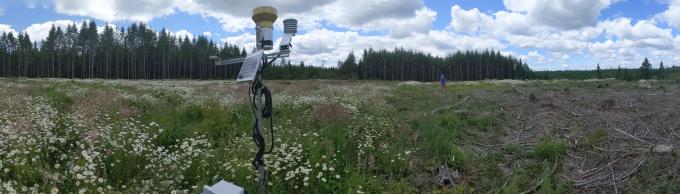
Critical Period Threshold Study
Effects of up to Five Years of Consecutive Weed Control and Delayed Weed Control on Douglas-fir and Other PNW Conifer Species
Introduction

Purpose
The VMRC initiated the Critical Period Threshold Study at one site in 2000 and three additional sites in 2001 to determine the number of years of vegetation control (up to five) required to maximize seedling growth of four PNW conifer species. In addition, this study will document the extent of growth losses that result from delaying vegetation control for one or two years on the same sites.
Methods
Study design
The study utilizes a randomized complete block design with a one-way treatment structure testing eight experimental treatments. At each of the four study sites, three to four replicate blocks were used to test two to four species independently. The sites represent different geoclimatic zones with different vegetation communities and climatic conditions. Each treatment plot consists of 36 Styro-15 seedlings planted in a 10 ft x 10 ft grid, surrounded by a row of buffer trees.
Sites


The Sweet Home site was installed in the winter of 2001 and is planted with Douglas-fir and western red cedar. The site is on the western slope of the Cascade Range with variable vegetation composition that usually invades extremely quickly. The site was harvested by feller-buncher in March of the previous year. Due to concerns about compaction during harvest, the site was subsoiled (ripped) using one tooth tool attached to the excavator after completion of excavator piling.
The Seaside Site was installed in the winter of 2001 near the town of Seaside, OR in an area characterized by dense spruce hemlock forests. These forests typically have dense overstories, and competing vegetation is slow to invade after harvest. The plant community that eventually invades is dominated by salmonberry, red alder, sword fern and herbaceous species. Excavator piling was undertaken, but no sub-soiling treatments were applied. The study was replicated across Douglas-fir and western hemlock at this site.
Site Preparation
All sites received similar slash removal treatments, consisting of excavator piling of slash outside of treatment areas. While piling slash, the excavator also pulled existing shrub clumps. Within all treatmentplots and buffer rows a follow-up herbicide treatment was applied to control any potentially problematic sprouting hardwoods.
Treatments
The eight treatments being evaluated include a no treatment "check", one to five consecutive years of herbicide treatments beginning the first year, four consecutive years of herbicide treatments beginning the second year, and three consecutive years of herbicide treatments beginning the third year. With T's (herbicide treated) and O's (untreated) representing individual years of the study, the treatments are: OOOOO, OOTTT, OTTTT, TOOOO, TTOOO, TTTOO, TTTTO, and TTTTT.
Vegetation Control
Vegetation control for treated plots (T) was conducted with the goal of maintaining competing cover below 25% during the entire the growing season. Thus, if greater than 25 % cover remained after treatment or was expected to develop later in the season, additional treatments were applied. For all plots designated for treatment in the first year (T''''), a broadcast fall site preparation application including sulfometuron, metsulfuron and glyphosate was made. Additional treatment with imazapyr was included where necessary. In subsequent years fall herbicide applications were made to plots designated for treatment the following year, if those plots contained species unlikely to be controlled by spring applications. Spring treatments included broadcast applications of atrazine and clopyralid, with follow-up spot treatments using glyphosate. Products and rates were adjusted to target the species present.
Measurements
Initial heights and calipers were assessed within a few weeks of planting at all sites. Each subsequent fall, seedling height, basal diameter and DBH have been measured. Both total cover of all vegetation as well as cover for each plant species individually has been estimated in late summer in six 1-meter radius tree-centered subplots within each treatment plot.
Statistical Analysis Analysis of covariance was run separately on diameter, height and stem volume data for each site by species combination, with initial diameter as the covariate. Mortality was analyzed using analysis of variance. In all cases, data were transformed as needed to fulfill model assumptions, treatment means were compared using a Fisher's protected LSD test and a significance level of a = 0.05 and back-transformed means are presented.
Results
Figure 1. Mean total vegetation cover (sum of individual species cover) for Summit and Marcola sites measured in July for each of the first three years post planting.The rate of weed invasion varied among sites with the highest first-year untreated plot cover occurring at Sweet Home and the least at Seaside (Figure 1). Average vegetation cover was maintained well below the 25% threshold for all "T" treatments every year except 2002 at both Starker (year three) and Sweet Home (year two), when all "T" treatments exceeded 25% cover. In other years (and at Seaside in 2002) some individual "T" plots exceeded 25% cover, but treatment averages did not. While cover goals were exceeded in these cases, herbicide treatments did reduce cover relative to "O" plots. Given the chemicals applied and variability in both the environment (rainfall) and weed communities, the desired covers could not always be achieved. It is the nature of these kinds of experiments that it is not always possible to control all of the factors that influence the growth of weeds on plots. Therefore, it is important to interpret results in light of the actual levels of control that were achieved.
Mortality and Growth
Starker Site
Cumulative mortality has remained extremely low (< 4%) in all Douglas-fir treatments and low to moderate (<20%) for all treatments in the remaining three species, but mortality has begun to increase in several treatments, especially in the check treatment (OOOOO) in grand fir and western red cedar (Figure 2). We anticipate that as the woody vegetation component begins to assert itself in the next several years, mortality will increase in plots receiving little or no weed control, and more significant differences will develop.

Figure 2. Cumulative mortality by species through year 5 at the Starker CPT site.
Within each species, there was no statistical difference in fifth-year volume whether three years of herbicide treatments were applied in years 1-3 (TTTOO) or years 3-5 (OOTTT) (Table 1). Four years of herbicide treatments have also resulted in similar fifth-year volume when applied in years 1-4 (TTTTO) or 2-5 (OTTTT), with the exception of grand fir, in which earlier treatment increased growth. One year of weed control (TOOOO) did not significantly increase growth through year five in any species except grand fir; mean volume increased more than three fold in western red cedar, although this difference was not statistically significant.
Sweet Home Site
Cumulative fourth-year mortality in Douglas-fir ranged from 6% to 13% among treatments, but differences were not statistically different (Table 2). In western red cedar, on the other hand, mortality ranged from 14% to 41%, with the highest mortality occurring in treatments where weed control was delayed (OOTTT and OTTTT) or not used at all (OOOOO).
Although growth tended to increase substantially with increasing years of weed control for both species, four years of control (TTTTO) did not result in significantly more fourth-year volume than three years of control (TTTOO) in either species, despite a non-significant 24% increase in mean volume for Douglas-fir (Table 1). Through four years, the most intensive treatment, TTTTT, increased fifth-year volume relative to untreated plots (OOOOO) by 718% and 1600% for Douglas-fir and western red cedar, respectively.
In Douglas-fir, there was no statistical difference in fourth-year volume whether two years of herbicide treatments were applied in years one and two (TTOOO) or years three and four (OOTTT) (Table 1). In western red cedar, however, there was a 200% increase in year four volume when two years of weed control were applied in years one and two. In both species, one year of weed control (TOOOO) significantly increased growth through year four relative to the check (OOOOO), increasing volume by 95% in Douglas-fir and 367% in western red cedar.


Seaside Site

At the Seaside site Douglas-fir growth has tended to increase with increasing years of weed control, whereas no treatment increased western hemlock growth relative to the check (OOOOO). In Douglas-fir four years of weed control (TTTTO) increased volume by 24% relative to three years of weed control (TTTOO), but these means are not statistically different. Through four years, the most intensive treatment, TTTTT, increased volume relative to untreated plots (OOOOO) by 108% in Douglas-fir.
There was no statistical difference in Douglas-fir fourth-year volume between treatments in which two years of herbicide treatments were applied in years one and two (TTOOO) or years three and four (OOTTT) (Table 1). In both species, one year of weed control (TOOOO) did not improve growth relative to the check treatment (OOOOO).
Discussion
With five years of data in hand for the Starker site and four years of data in hand for the Seaside and Sweet Home sites, we are beginning to be able to assess the number of years of weed control needed to maximize growth. At the Starker site, fifth year treatments appear to have increased volume in three of four species, suggesting that the critical period extends at least through year five in those species. It will likely take a few more years of growth before the magnitude of differences brought about by year five treatments become clear. For western red cedar at Sweet Home and both species at Seaside, it appears that the critical period may extend only through year three, with fourth year weed control showing little effect thus far. However, it is still too early to make this claim and fifth-year data will enable us to get a much better sense of responses at these sites.
With woody vegetation beginning to come on strong in several of these sites, suppressed trees are continuing to struggle and the magnitude of the differences in growth between treatment extremes is continuing to expand. On the one hand mortality is increasing in the absence of weed control for species such as grand fir and western red cedar at the Starker site, while on the other hand, Douglas-fir TTTTT plots at the Starker site are nearing crown closure. Insights into the interaction between sites, species and treatments remain an important outcome of this study. For example, whereas western hemlock has been more responsive than Douglas-fir to weed control in terms of percentage increase in volume at the Starker site, weed control has had little effect on western hemlock growth at Seaside in spite of Douglas-fir growth increasing by more than two-fold at that site.
Future planned activity
Fifth-year treatments were carried out at the Sweet Home and Seaside sites in the spring of 2005. Vegetation will be assessed in late July 2005 at Sweet Home and Seaside and trees will be re-measured in October. As soon as data are collected we will begin work on a manuscript incorporating fifth-year results from all three sites.

